Advanced Planning Systems (APS) are often presented as the ultimate solution for supply chain challenges. They promise seamless integration, better forecasting, and optimized decision-making. But are they always the right choice?
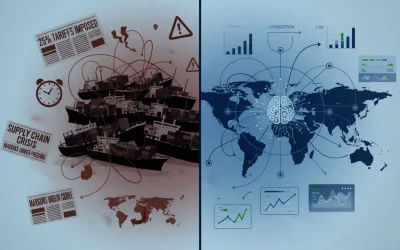
At Qwinn Business Partners, we see a different side to APS implementations. These projects are complex, expensive, and time-consuming. They demand significant investments in both technology and organizational change. Often, they paralyze the planning organization for years, only to deliver outcomes that fall short of expectations. So why not take a step back and ask: Is there an easier, more cost-effective way to tackle supply chain issues?
The Pitfalls of APS Implementation
Implementing an APS can feel like deploying a massive ERP system. It’s not just about the software; it’s about rethinking processes, training teams, and hoping the technology can deliver what’s promised. Unfortunately, many businesses find themselves stuck in “implementation limbo,” spending years—and millions—without seeing the expected results.
This isn’t to say APS doesn’t have its place. But before diving into a full-scale implementation, it’s worth considering if the problem lies elsewhere. Are there foundational issues in your supply chain that could be solved more directly, without the complexity of APS?
Rediscovering the Power of Operations Research and AI
Operations Research (OR) has been solving complex supply chain problems for decades, leveraging mathematical and analytical techniques to optimize processes. These methods—such as linear programming, optimization modeling, and statistical analysis—form the backbone of many advanced supply chain solutions.
Interestingly, much of what we now call Artificial Intelligence (AI) builds on these foundational OR techniques. AI adds an extra layer of sophistication, enabling systems to learn from data, make predictions, and adapt to changing conditions. For example, machine learning algorithms often incorporate OR-based optimization models to improve accuracy and decision-making.
Thanks to advancements in computing power, cloud technology, and data availability, the combined use of OR and AI has become both technically feasible and financially accessible. Together, these tools provide businesses with the ability to tackle specific supply chain challenges without the overhead of a full APS implementation.
Why Consider OR and AI-Based Solutions?
Let’s be clear: we’re not saying APS doesn’t have its place. But before committing to such a massive undertaking, it’s worth exploring whether a targeted, OR- and AI-based solution might achieve the same (or better) results with less hassle.
Here’s why these solutions deserve a closer look:
- Cost-Effective: Developing OR- and AI-based tools is often more economical than investing in expansive APS platforms.
- Faster to Deploy: These solutions can address specific supply chain challenges without the lengthy timelines of an APS project.
- Powerful and Flexible: OR techniques paired with AI can solve complex problems, such as dynamic pricing, demand forecasting, and inventory optimization, with precision.
- Minimally Disruptive: These tools integrate with existing systems more easily, minimizing operational upheaval.
For example, machine learning algorithms can analyze historical data to improve demand forecasting, while OR models can optimize transportation routes or inventory levels. These focused solutions deliver measurable results without requiring a complete system overhaul.
That said, these approaches do come with trade-offs. They may require more effort to integrate into existing systems, and scalability depends on how the solution is designed. However, for many companies, these trade-offs are well worth it.
AI and OR: The Future of Supply Chain Innovation
AI isn’t about replacing OR—it’s about enhancing it. OR provides the proven methodologies to model and solve complex problems, while AI adds the capability to learn and adapt in real time. Together, they offer a powerful toolkit for supply chain optimization, enabling businesses to unlock new levels of efficiency, resilience, and flexibility.
By leveraging AI and OR, businesses can:
- Predict and respond to supply chain disruptions with greater precision.
- Optimize resources and costs dynamically, based on real-time data.
- Gain deeper insights into customer behaviors and market trends.
These tools are no longer just theoretical—they’re practical, affordable, and transformative.
A Balanced Approach
Before jumping into an ambitious APS project, take a moment to assess your needs. Are there specific bottlenecks or inefficiencies that could be addressed with a simpler solution? Sometimes, focusing on the core issues—like improving inventory management or optimizing transportation routes—can deliver more impact than a large-scale APS ever could.
By tackling foundational problems first, you also build a stronger case for whether an APS is truly necessary. And if you do decide to go the APS route later, your supply chain will already be in better shape to support the implementation.
Let’s Start the Conversation
This isn’t about dismissing APS—it’s about exploring alternatives. At Qwinn Business Partners, we believe that every business should carefully evaluate its options before committing to any large-scale project.
The resurgence of Operations Research, combined with modern AI capabilities, offers a compelling opportunity to rethink how we approach supply chain challenges. These solutions might not be as flashy as APS, but they’re often more practical, achievable, and impactful.
What do you think? Is it time to rethink the reliance on APS? Let’s discuss how OR- and AI-based solutions could work for your business.