The Origins of VUCA
The term VUCA—Volatility, Uncertainty, Complexity, and Ambiguity—originated in the 1990s as part of U.S. military strategy to navigate the unpredictable conditions of modern warfare. Its relevance quickly spread to the business world as companies faced the growing complexities of globalization, technological advancements, and interconnected supply chains.
“It is not the strongest, nor the most intelligent of the species that survives, it is the one that is the most adaptable to change.” ― Charles Darwin
This famous quote perfectly encapsulates why the VUCA framework became so essential: it provides a lens to understand and adapt to an unpredictable world.
The Rise of VUCA: A World in Flux
Businesses are now operating in a world of fragile interconnections. For supply chains, these disruptions have been particularly acute: transportation bottlenecks, raw material shortages, and rising geopolitical tensions all highlight the vulnerabilities created by the VUCA environment.
So why is VUCA intensifying? There are several key drivers at play like:
- Increased Interconnectedness: A breakdown in one part of the global economy often ripples across supply chains worldwide.
- Technological Pace: While technology is a critical enabler, it also accelerates change, leaving businesses struggling to keep up.
- Environmental and Geopolitical Challenges: From natural disasters to trade wars, uncertainty has become the norm rather than the exception.
To illustrate this, we have looked at data from the Global Economic Policy Uncertainty Index, which is the excellent research work by Scott Baker, Nicholas Bloom, and Steven Davis. This index tracks and indexes economic policy uncertainty across countries, and its sharp spikes during events such as the 2008 financial crisis, Brexit, and the COVID-19 pandemic are a testament to the increasing unpredictability of the global economy.
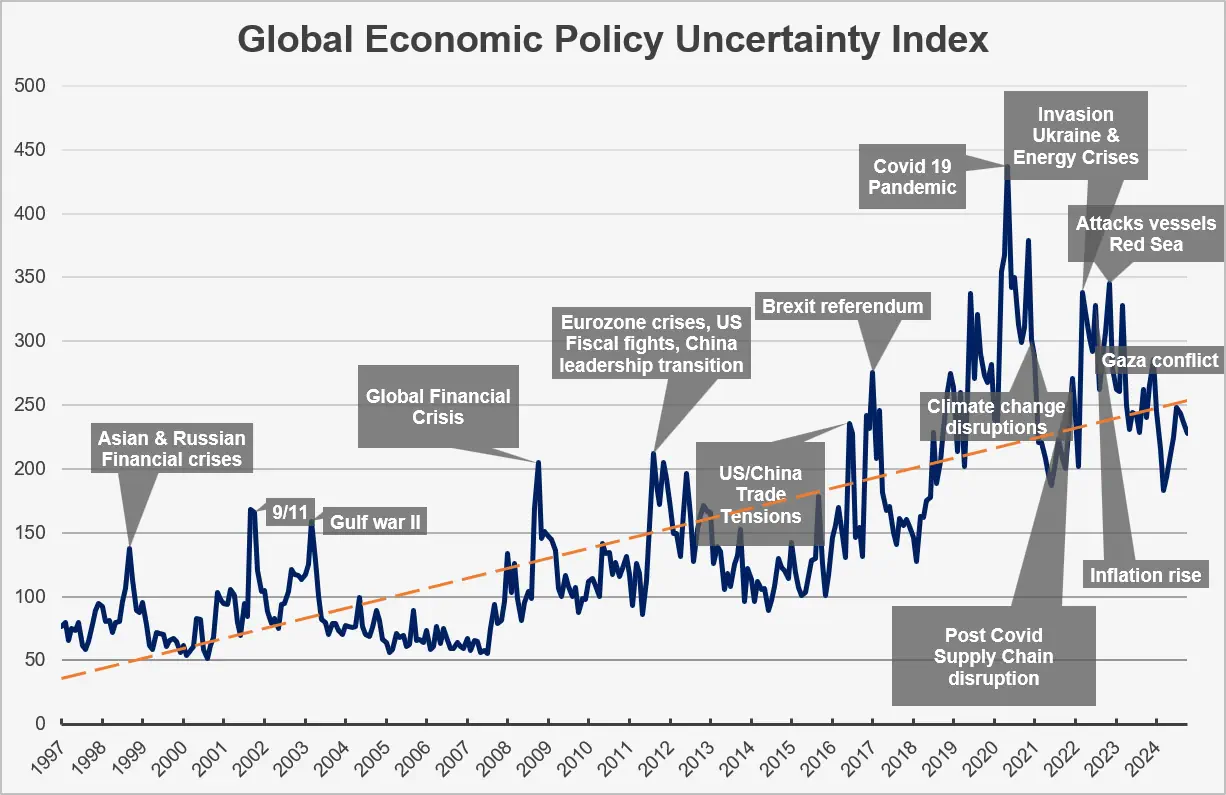
Visual: rising trend in the Global Economic Policy Uncertainty Index, data source: www.policyuncertainty.com
The Implications for Businesses and Supply Chains
In a VUCA world, businesses face a stark choice: adapt or become irrelevant. For supply chains, the stakes are even higher. A supply chain that lacks visibility, is rigid, or overly reliant on manual processes becomes vulnerable to disruptions. For instance, during the pandemic, supply chains with limited transparency struggled to identify bottlenecks or mitigate delays.
At the same time, over-investing in redundancy and resilience can create inefficiencies. A supply chain that holds excessive inventory, or one that builds too many backups, risks becoming prohibitively expensive and less competitive. This is why striking the right balance between efficiency and adaptability is critical.
As management guru Peter Drucker famously noted, “The greatest danger in times of turbulence is not the turbulence—it is to act with yesterday’s logic.”
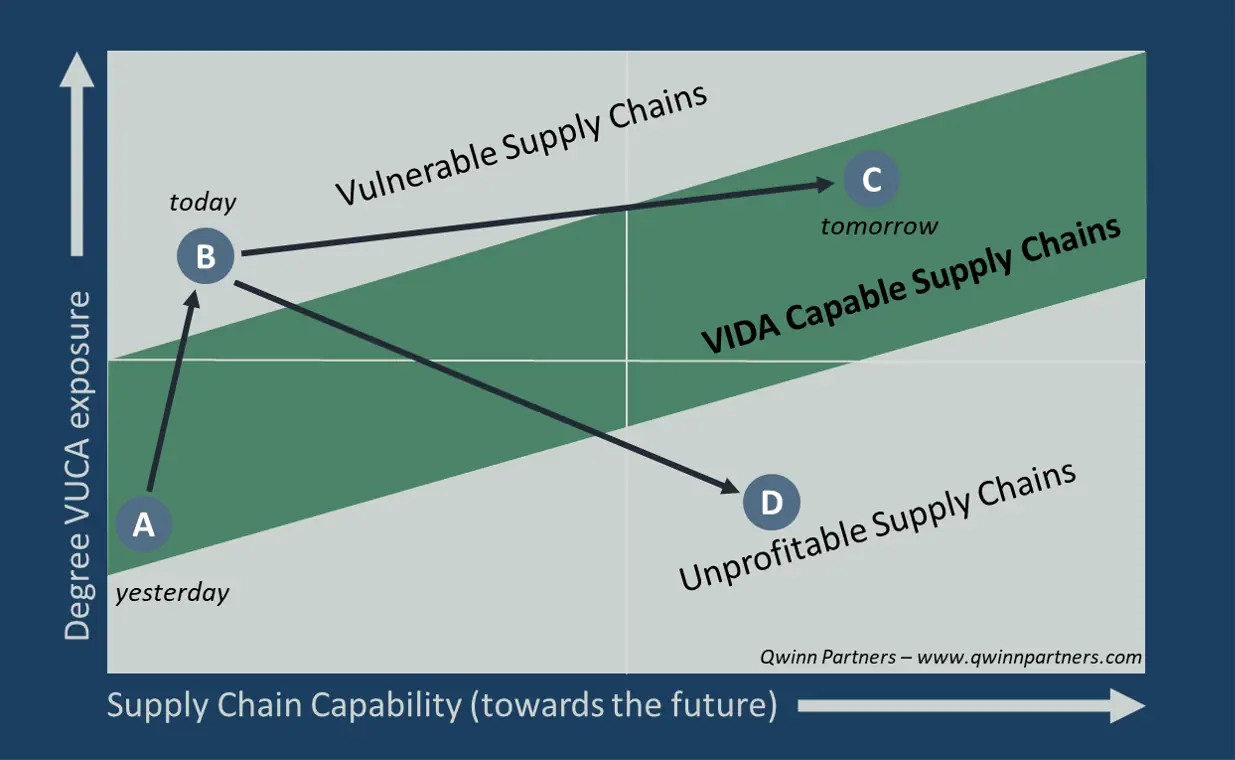
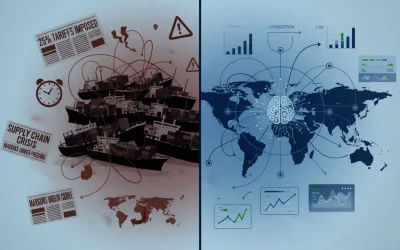
Visual: representation of the VIDA™ framework adapting to VUCA world
A: A Modern Framework for Navigating VUCA
At Qwinn Partners, we help businesses meet the challenges of a VUCA world by using the VIDA™ framework, which provides a roadmap on based on four interconnected elements that ensure supply chains are both resilient and cost-effective:
- Visibility: How much of your supply chain is visible? Supply chains can only react to disruptions they can see. Improved data-sharing, real-time tracking, and predictive analytics are vital to achieving end-to-end transparency.
- Integration: How wide is the scope of your supply chain’s influence? Integrated supply chains break silos and function as cohesive ecosystems. Collaboration with partners, suppliers, alignment across functions, and connected goals are essential for long-term adaptability.
- Agility: How fast can your supply chain pivot? How fast and how much can you impact? Agility is the capacity to pivot quickly and make impactful decisions in the face of uncertainty. Whether it’s rerouting shipments or reallocating resources, agility can mean the difference between seizing opportunities or suffering losses.
- Digital: The enabler of visibility, integration, and agility. Digital tools such as AI, IoT, and blockchain allow supply chains to automate processes, improve decision-making, and scale operations efficiently. Digital transformation isn’t optional; it’s the backbone of resilience in a VUCA world.
Conclusion: Future-Proofing Your Value Chain
The speed of change is accelerating, and the forces driving VUCA show no signs of slowing. Businesses that fail to adapt risk obsolescence, while those that overreact risk inefficiency. The key lies in finding the right balance, and the VIDA™ framework offers a practical path forward.
At Qwinn Partners, we specialize in helping leaders make their value chains future-proof. For a complimentary VIDA™ Scan and consultation, reach out to us today. Together, we can ensure your business not only survives but thrives in the VUCA world.