You Can Buy the Technology Later. You Cannot Buy the Capability.
Even the people who build AI now warn that it could be a bubble, and most AI projects still show no profit. So it is understandable that supply chain leaders are careful. But the fear is directed at the wrong risk: you can buy the technology later, not the readiness to use it.
I The Argument
The Real Risk Is Not the Bubble
The talk about an AI bubble is getting louder, and it now comes from the people who build AI themselves. Sam Altman has said that investors are too excited and that someone will lose a lot of money. Jeff Bezos calls it an industrial bubble. Sundar Pichai of Google warns that, if it bursts, no company will stay untouched. On top of that, a much-quoted study from MIT found that about 95 percent of company AI projects give no measurable profit. So it is logical that supply chain leaders are careful. A Gartner survey among senior supply chain leaders shows that 83 percent use AI only in small steps, and do not yet change the way they work. So why would you spend money now?
The caution is understandable. But it is directed at the wrong risk.
AI software becomes better and cheaper all the time. If you wait, you can buy a better tool later for less money. But there is one thing you cannot buy later: the readiness to use it. That means clean data, processes that are redesigned around what AI can do, clear roles so that someone owns each decision, and a team that has learned from real experiments where AI works and where it does not.
That readiness is what I call capability. It is not for sale, and it takes years to build.
You can buy the technology later. You cannot buy the capability. Qwinn Business Partners
None of this is new. It is the most constant pattern in the history of technology, and I have been through it three times myself.
II The Pattern
Technology Survives a Crash, Most Owners Do Not
Bubbles around new technology are not new. Think of the railways in 1873, or the internet in 2000. Every time the story is the same: a real technology, a wild wave of investment, and then a hard crash that ruins most of the people who put their money in.
And every time, the technology itself survives and changes the economy. The railways kept growing after 1873. The fiber-optic cables from the dot-com years later carried the internet that we use today.
The winners after the crash were not the companies that spent the most. Amazon did not win because it invested the most in 1999. It won because it stayed alive and built something that people really wanted, while others followed the hype. Google did the same.
This is not a coincidence. Economists have found the same three phases, a boom, a crash, and then a long payoff, in five technology waves over 250 years. The boom builds the infrastructure. The companies with patience use it afterwards.
This is the history behind the argument: two centuries of booms, crashes, and the slow phase afterwards in which the winners were made.
The Crashes
Technology survives, the owners usually not
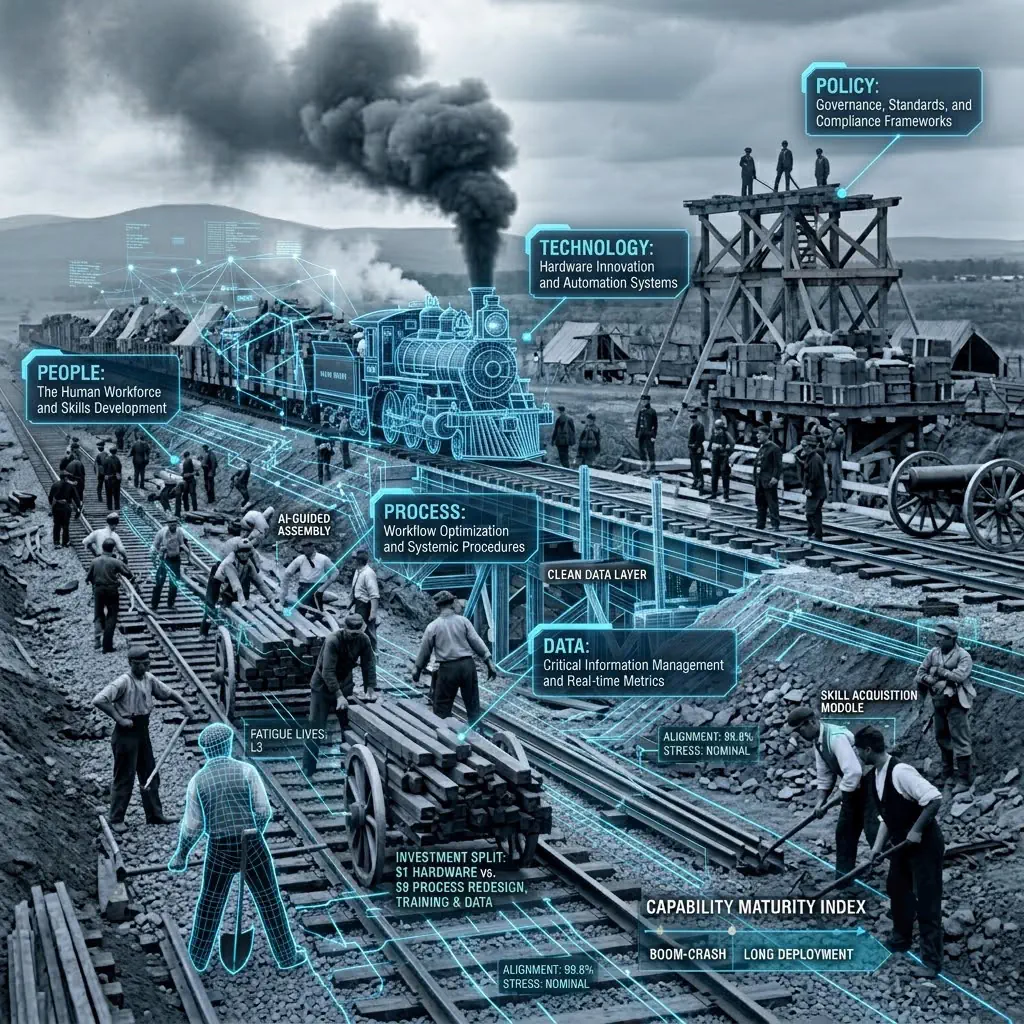
Go back to 1873. In that time the railways were the new technology, like AI today. Investors put a lot of money into building tracks, sure that it would pay off. But they built too much. Many of the new lines could not earn enough to pay their debts. In September 1873 the bank that had invested the most in them, Jay Cooke and Company, went bankrupt.
That frightened everyone. Banks called in their loans. Investors sold their shares. The New York stock exchange was closed for ten days. The crisis that followed was so deep that people called it the Great Depression, until the 1930s took over that name. Most people who had bet on the railways lost everything.
And then something strange happened. The railways kept growing. The 1880s became the biggest decade of railway building in American history. The technology did not die with the crash. It became the backbone of the economy.
The year 2000 went the same way. Investors threw money at almost every company that had dot-com in its name. Then the Nasdaq fell by about 78 percent and around 5 trillion dollars disappeared. Pets.com and Webvan closed their doors. Amazon lost about 90 percent of its value. But the more than 500 billion dollars of fiber-optic cable that the telecom companies had built too much of stayed there, and it made the next internet wave cheap to build. Amazon and Google did not only survive, they became giants.
In both crashes the technology survived. The people who owned it, in most cases not.
The Framework
The same story, five times in 250 years
In 2002 the economist Carlota Perez studied every big technology since the Industrial Revolution. Each one went through the same three phases. First the money comes in and finances much more than the world can use at that moment, until the prices become far too high. Perez calls this the installation phase, and it always ends in a bubble. Then the bubble bursts and the speculators disappear. And then, in the third phase, the technology slowly spreads through the whole economy in the decades that follow. Perez calls this the deployment phase. That is where most of the value is created.
She counted five of these waves: steam and railways, then steel and electricity, then oil and the car, and then computers and the internet. AI looks like the sixth.
| The technology | The frenzy and the crash | What spread afterward |
|---|---|---|
| Steam and railways, 1830s | Railway mania, then the crash of 1873 | National rail networks |
| Steel and electricity, 1880s | Booms and busts of the 1890s | Power grids and the modern factory |
| Oil and the car, 1900s | The Roaring Twenties, then the 1929 crash | Highways, suburbs, mass production |
| Computers and the internet, 1970s | The dot-com bubble of 2000 | The cloud, e-commerce, the smartphone |
| Artificial intelligence, today | The boom we are in now | Still to come |
The most important lesson from this pattern is about who wins in the end. The companies that lead during the boom are almost never the companies that lead during the deployment. Amazon and Google were not the biggest spenders during the dot-com boom. They were the ones that were still standing, and still building, when it was over. The boom builds the infrastructure. The companies with patience use it afterwards.
The Mechanism
Why the payoff comes late
An example of a hundred years old explains the delay better than anything of today. Electricity came to the factories in the 1880s, but the productivity of those factories almost did not move for about forty years.
Why? In the beginning the owners simply took out the steam engine and put in an electric motor, and left everything else the same: the same building with many floors, the same machines around one central drive shaft. The technology was new, but the factory was not. So nothing improved. The improvement only came when a new generation rebuilt the factory around the electricity. They put a small motor on every machine, spread the machines over one floor, and organised everything around the flow of the work. That was the modern production line.
This is the point. None of that could be bought. All of it had to be learned. The motor you could buy. The new way of working, not.
The economist Robert Solow made a joke in 1987 that you could see computers everywhere, except in the productivity numbers. Later research by Erik Brynjolfsson and others gave this a name: the productivity J-curve. When a strong new technology arrives, the output often first goes down, while companies do the slow work of changing how they operate. After that it goes up, when that work is done. The dip is not a failure. It is the technology that is being absorbed.
The Objection
But is this AI bubble not bigger and stranger?
It is good to take the strongest counterargument seriously. This boom does look bigger and stranger than the ones before. On some measures it is many times larger than the dot-com bubble. And the money moves in circles: the chip maker invests in the AI company, which spends the money on the chips, which makes the chip maker look busier than it really is. A small number of companies now form an unusually large part of the stock market. If that falls apart, the crash can be very hard.
But the other side also has a real point. Different from the dot-com companies, the AI leaders of today earn real revenue, and the big companies have much more cash than in 1999. So maybe it deflates slowly instead of bursting.
But look at what this discussion is really about. It is about the timing and the size of the crash, not about the question whether AI will spread. About that, both sides agree: it will. Whether the bubble bursts next quarter or leaks slowly for years, this only changes when the deployment phase starts. It does not change who wins it. A bigger boom simply builds more infrastructure for the patient companies to take over later. If anything, it makes capability more valuable, not less.
III Why Most Fail
Why Most AI Projects Fail
Come back to the number from the beginning: about 95 percent of company AI projects show no measurable profit. It is tempting to read this as proof that AI does not work. But it is the opposite. The research firm Gartner points to the same thing from another side, and expects that more than 40 percent of the agentic AI projects, the projects where the software acts on its own, will be stopped before the end of 2027. Two numbers, one message: most AI projects fail, and the models are not the reason.
They fail because companies put AI on top of the old way of working and change nothing else. It is the same mistake that the factory owners made when electricity arrived, and it took them decades to repair, as I explain in The Long View above. It is exactly what happens with AI now.
The symptoms are always the same. Data that is too messy for the AI to trust. Processes that nobody has redesigned. And nobody who really owns the result.
The 95 percent does not mean that AI fails. It means that most companies skip the rebuild. That is the part you can repair, and the part that your competitors forget.
IV What You Cannot Buy Later
The Advantage Is in the Preparation
So the money should not go to a big bet on one AI company or one platform. That is exactly the kind of bet that a bubble destroys, and nobody knows yet which companies will win. The money should go to the preparation that makes every tool work:
- clean, reliable data
- processes that are redesigned around what AI can do
- clear roles, so people know who owns which decision
- a team that has learned from real experiments where AI works and where it does not
Economists have a name for this preparation: complementary capital. A technology only pays off when the organisation around it is rebuilt to use it, and that rebuild, the clean data, the new processes, the trained people, is itself a form of capital. And it is much bigger than the technology it supports. Erik Brynjolfsson found that for every dollar a company spent on computer hardware, it needed up to nine dollars more for software, training, and the redesign of processes, to really get the benefit. In studies of large ERP systems, less than one fifth of the total cost was the software. The rest was the rebuild of the business around it.
This is also why waiting is a trap. The company that sits still during the boom will buy cheap software later, but it will still have the old factory. It will own the motor, but it will not know the new production line. The tool is not your advantage. Knowing how to use it, that is your advantage.
V From Experience
What I Have Seen Myself
For me this is not only theory. I have been inside three of these waves.
The first was ERP, the big systems that connect the finance, planning, and logistics of a company. The software already existed for years, but the rush to install it came around the year 2000, because of the millennium bug and because of the fear to be the only company that did not do it. Most of those business cases were never realised. Companies bought the software and kept their old way of working.
I saw the reason from close by. One SAP project where I worked failed the first time, because nobody had thought about the processes, or about how the people would use it. The second attempt did work, and I could lead it, because I stood between the business and the technology and understood both sides. The same software. A different result. The difference was the rebuild.
Then came the dot-com boom. I was at Lafarge. We burned about 28 million euro on e-commerce projects that neither our customers nor our own people wanted, pushed by the fear of missing out and by shareholders who believed that a company that did nothing online would fall behind. When the bubble burst, we stopped everything. What stayed was a few simple websites. The money bought the look of being modern. It built no capability.
And today the AI projects that I see get stuck, do not get stuck on the technology. They get stuck on messy data, unclear processes, and nobody who knows who is responsible. Three waves. Every time the same pattern.
Money that you spend to look modern builds nothing that lasts. Money that you spend to rebuild the way you work pays off in every crash that comes after it.
VI What to Do Now
Where to Put Your Money
So keep investing. Only put the money where it grows. This is where.
See AI experiments as learning, not as quick profit
Expect the dip before the rise. The goal now is knowledge, not profit. Take a real problem, try AI on it, and learn where it helps and where it breaks.
Rebuild the factory, not only the motor
Clean the data. Redesign the process around what AI can do. Give one person the ownership of the decision. This is the work that turns a model into a result, and the work that most companies skip.
Do not bind yourself to one AI vendor
Nobody knows yet which AI companies will win, and a large part of the market today is hype. Commit to the capability, not to the tool. Then a shake-out between the vendors makes you stronger, instead of leaving you behind.
Decide who is responsible before you automate
If you cannot say who owns the result, you are not ready. First arrange the responsibility, then add the AI.
Score your readiness honestly
Give yourself a score on five points: People, Process, Technology, Data, and Policies. That honest scorecard, not the software, tells you what to repair before you spend. It is the groundwork behind a real VIDA™ result.
VII The Bottom Line
The Reward Comes After the Crash
In every one of these waves, the biggest reward did not come during the boom, but in the long period after the crash, when the technology spread through the economy. The AI bubble will also deflate, like every bubble before it. When that happens, the technology will still be here. Maybe the winning companies will be different ones.
But whoever enters that new world with real, hard-earned experience in using AI, will be the one who wins. There is no reward for waiting to buy the best tool. It will be cheaper and better whenever you are ready for it. The capability to use it is the only part that cannot wait.
So keep investing. In capability.
About Qwinn Business Partners
We are experienced people from the industry, specialised in supply chain and value chain strategy. We work as an extension of your leadership team, independent of any solution and measurable in our impact, on the line between business and technology, where most AI initiatives are won or lost.
The VIDA™ framework and its five conditions, People, Process, Technology, Data, and Policies, are the way in which we make AI readiness visible, before the money is spent.
Sources
The facts about 1873 and the railways come from the Library of Congress and Encyclopedia.com. The dot-com crash and the overbuilt fiber-optic cable come from International Banker and Finbold. The three phases of a technology wave are from Carlota Perez. The story of electricity and the factories is based on Paul David, via the World Economic Forum. The productivity J-curve and complementary capital come from the work of Erik Brynjolfsson and colleagues. The remarks about the bubble come from CNBC (Altman and Bezos) and Ars Technica (Pichai). The 95 percent is from a study by MIT, and the supply chain figures from Gartner. The observations about ERP, Lafarge, and current projects are my own.