


Toyota is renowned for its lean production methods—eliminating waste, achieving just-in-time perfection, and setting the global standard for operational efficiency. Yet when the massive 2011 earthquake devastated Japan, Toyota resumed production faster than any competitor.
The difference wasn’t their supply chain capability—it was their deliberate investment in resilience alongside efficiency. While other manufacturers optimized purely for normal operations, Toyota built strategic redundancies, cultivated deep supplier relationships, and maintained recovery protocols that seemed like costly overhead—until disaster struck.
This wasn’t luck. Toyota understood a critical truth that most supply chain leaders are just discovering: excellence in normal operations doesn’t guarantee survival during disruption.
In today’s VUCA environment (Volatility, Uncertainty, Complexity, Ambiguity) —where geopolitical tensions, climate events, and economic volatility have become the norm—companies can not keep continuing to optimize supply chains for a “normal” that no longer exists. The paradigm must shift from efficiency-first to a dual mandate: building supply chain capability AND supply chain resilience as complementary strategic assets.
- • •
The False Optimization Trap
When examining different data sets, the data is undeniable: we are not experiencing isolated disruptions anymore—we are living in a fundamentally more volatile world. One leading data set, the Global economic policy uncertainty Index (GEPU) has reached levels never seen before, with geopolitical tensions reshaping trade architecture and supply chains facing cascading disruptions that were once considered “black swan” events.
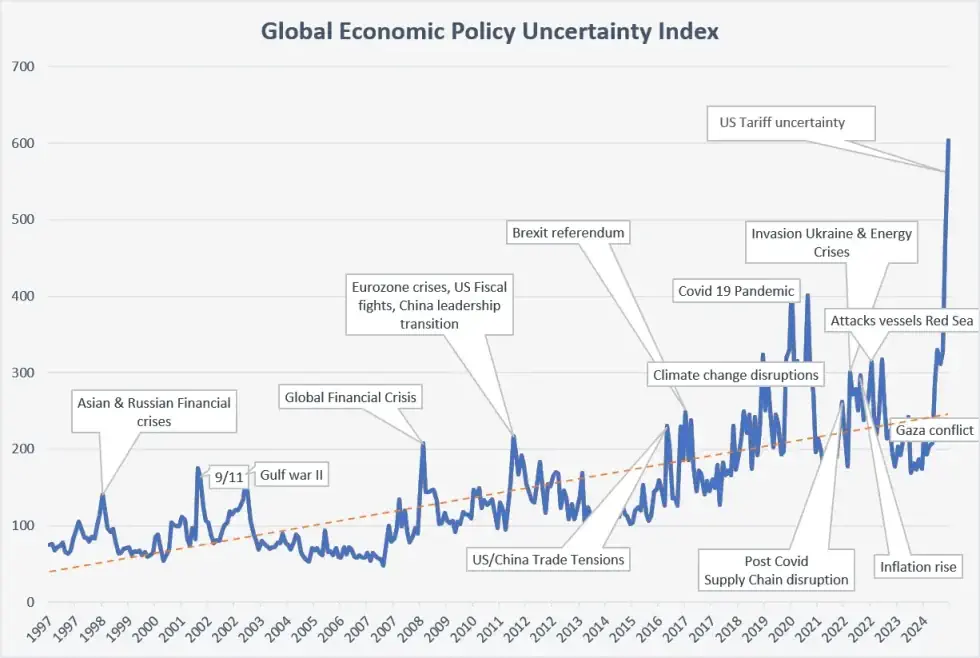
Chart: Global Economic Policy Uncertainty (GEPU) Index – Escalating volatility demonstrating the shift from isolated crises to persistent instability.
Every time a major disruption hits—COVID-19, Suez Canal blockages, semiconductor shortages, trade wars, Red Sea attacks—CEOs turn to their supply chain leaders with the same urgent question: “How are you going to fix this?”
The uncomfortable truth is that supply chain leaders no longer can solve a strategic business problem with just operational band-aids.
Most of us built our careers in supply chain organizations that have been optimized for a predictable world that no longer exists. Our KPIs rewarded efficiency metrics—inventory turns, cost per unit, delivery speed. Executive dashboards celebrate lean operations and just-in-time perfection. Investment committees scrutinize “unnecessary” safety stock and question backup supplier costs.
Meanwhile, the entire global order is fragmenting into competing blocs. US-China tensions aren’t isolated disputes—they’re part of a broader restructuring where Europe seeks strategic autonomy, regional powers like India and Brazil chart independent courses, and economic alliances fracture along ideological lines. The era of free-flowing trade, stable alliances, and predictable economic relationships is ending.
The Strategic BLINDSPOT
Companies excel at measuring what they save but often ignore what they sacrifice in the process: eliminated redundancy removes options, lowest cost suppliers all consolidated into one region of the globe, reduced buffers eliminate time to respond.
In an increasingly unstable world, these aren’t just supply chain questions anymore—they’re business strategy questions that require C-suite alignment and cross-functional commitment. Yet supply chain leaders are expected to solve them within existing operational budgets and efficiency mandates.
Inaction is perhaps becoming the highest-risk strategy. Organizations that continue reactive firefighting will find themselves permanently behind those who proactively invested in resilience.
The cost of preparation can pale beside the cost of being unprepared, something that many corporations are painfully experiencing in the current US import tariffs war.
- • •
The New Supply Chain Performance Equation
The situation requires a fundamental reframe of how we measure and build supply chain performance. Instead of optimizing for efficiency alone, leaders must master a dual equation:
Supply Chain Performance = f(Capability, Resilience)
Where capability determines performance under normal conditions, and resilience determines performance maintenance under adverse conditions.
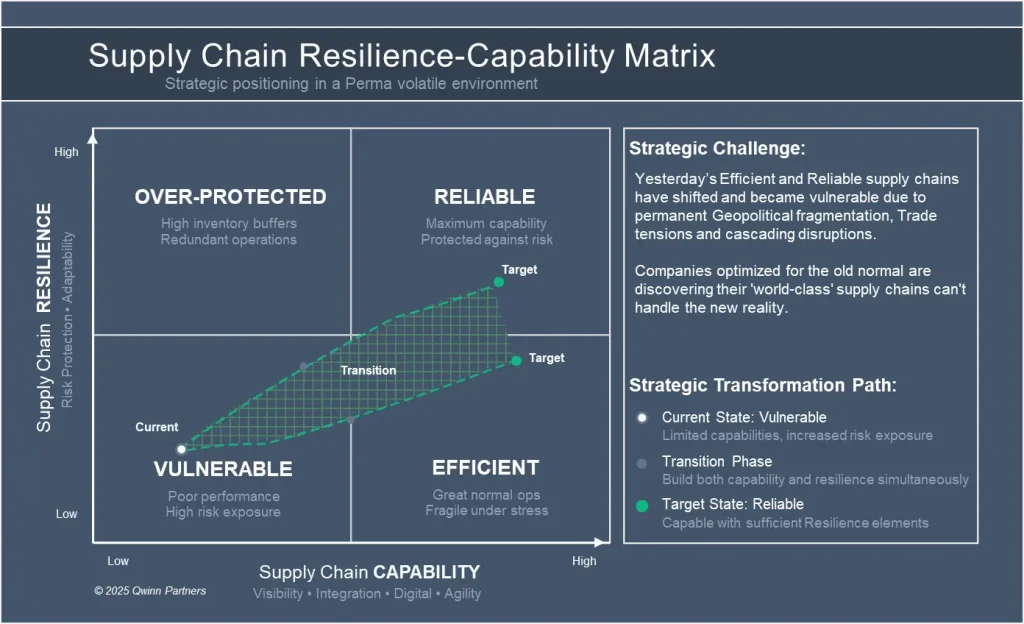
Supply Chain Reliability Matrix showing Capability vs Resilience
Chart: Supply Chain Reliability Matrix showing Capability vs Resilience
This mathematical relationship highlights a critical truth: both variables are essential, and the optimal balance between them varies significantly by industry context and business strategy.
A pharmaceutical company manufacturing life-critical drugs will rationally invest more heavily in resilience—accepting higher costs for supply security because the consequences of stockouts are possibly measured in lives, not just lost sales. Conversely, a toy manufacturer operating in highly seasonal, price-sensitive markets may optimize more toward capability—prioritizing speed-to-market and cost efficiency over extensive backup systems.
Neither approach is wrong; both reflect appropriate optimization for their respective industry dynamics, regulatory environments, and customer expectations. The key is making this trade-off deliberately rather than defaulting to pure efficiency optimization.
Building Supply Chain Capability Through VIDA
While resilience protects against disruption, capability drives competitive advantage during normal operations—and in today’s environment, you need both. Supply chain capability is built through what we call the VIDA framework, a concept we explored in earlier articles. The VIDA framework are four interconnected elements that determine operational excellence:
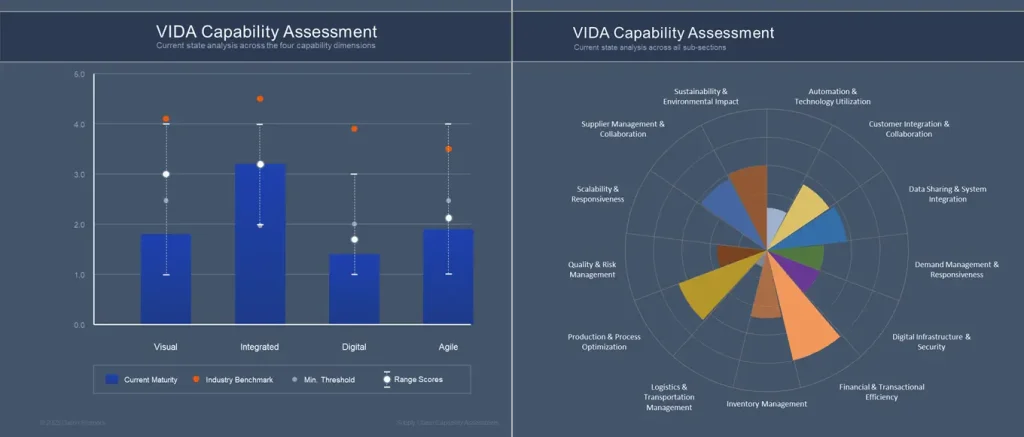
VIDA Supply Chain Framework Assessment across Visibility, Integration, Digital, and Agility dimensions
Chart: VIDA Framework Assessment across Visibility, Integration, Digital, and Agility dimensions.
- Visibility: End-to-end transparency across your supply network. When COVID-19 hit, companies with deep supply network visibility could identify at-risk suppliers weeks before competitors understood the scope of the problem.
- Integration: Seamless connection of processes, systems, and partners & customers into a cohesive ecosystem. Goes beyond technical integration to include collaborative planning and coordinated crisis response.
- Digital: Technology enablement through intelligent automation, AI-driven insights, and data-powered decision making. Digital leaders use technology for competitive intelligence, not just efficiency gains.
- Agility: Speed and flexibility to adapt to changing requirements. How fast and to which extend can changes be made in the entire chain.
The Multiplication Effect -These elements are multiplicative, not additive. Visibility without integration generates insight without action. Having real-time data on supply chain disruptions is worthless if your logistics are not agile enough to act on those insights. World class digital capabilities mean little if you only operate in your own company silo.
VIDA Supply Chain capability multiplication effect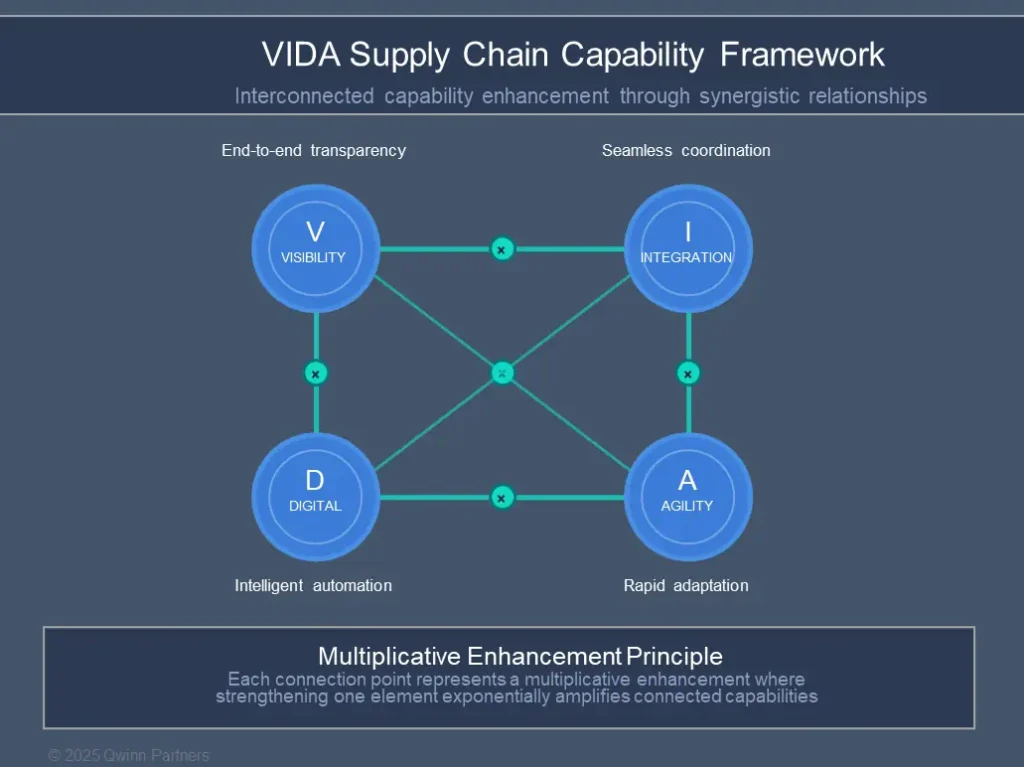
Chart: VIDA Supply Chain capability multiplication effect
The companies that thrived during recent disruptions—Amazon scaling delivery capacity, semiconductor manufacturers reallocating production, consumer goods companies shifting to e-commerce—all demonstrated mature VIDA capabilities that enabled rapid, coordinated responses to unprecedented challenges.
Resilience as Strategic Investment
While VIDA capabilities optimize day-to-day performance, resilience determines whether those capabilities survive when crisis strikes. This is where many organizations stumble—they treat resilience as an operational expense rather than a strategic business investment requiring board-level decisions.
“When a single supplier controls over 50% of your critical components, you don’t have a supply chain issue; you have a value chain vulnerability.”
Resilience isn’t about building redundancy everywhere; it’s about making calculated investments in four critical areas: robustness (structural strength to resist shocks), redundancy (backup capacity), recovery (rapid restoration systems), and adaptability (fundamental reconfiguration capability).
The question isn’t whether to invest in redundancy, but where these investments deliver the highest risk-adjusted returns based on how much of your revenue Value is potentially at Risk. Value at Risk (VaR) analysis—is a methodology that quantifies exactly what’s at stake by measuring how many days a company can continue supplying products before disruptions cause concrete losses.
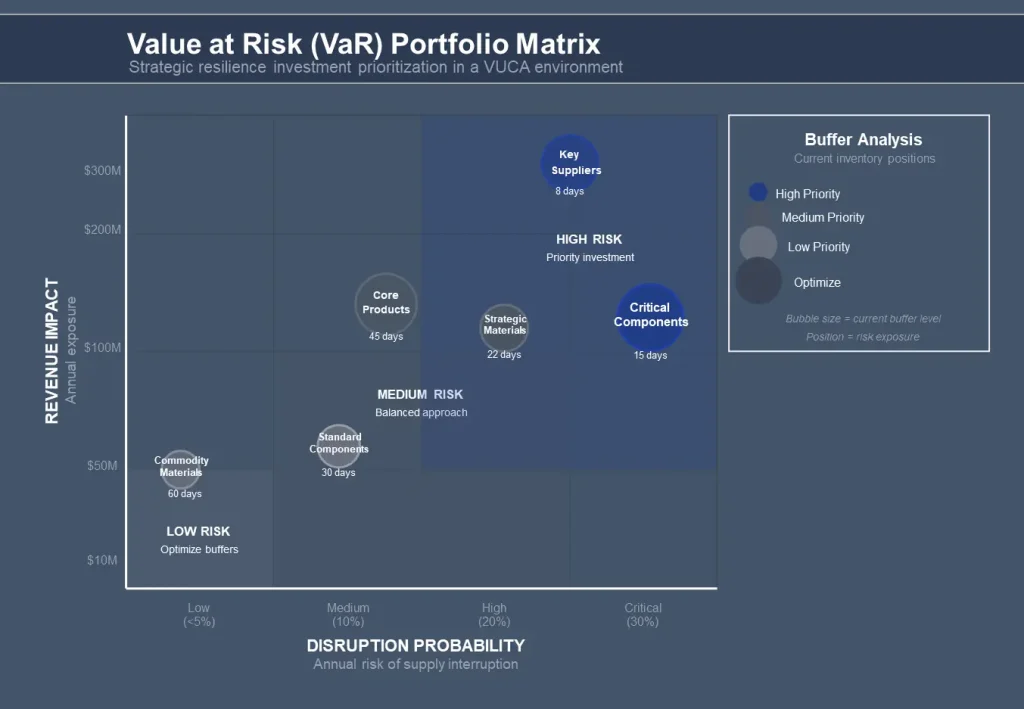
Supply Chain Value at Risk (VAR) Heatmap showing product portfolio mapped by revenue impact vs disruption probability
Chart: Value at Risk Heatmap showing product portfolio mapped by revenue impact vs disruption probability.
The Insurance Paradox – Resilience investments require different business cases than capability investments. While VIDA capabilities deliver measurable ROI through improved efficiency, resilience investments function more like insurance premiums—their value is realized when disruptions strike. The key difference is that resilient companies don’t just survive crises, they often emerge stronger by gaining customers and market share from competitors who couldn’t maintain operations during industry-wide disruptions.
This fundamental difference means resilience decisions cannot be delegated to operational teams working within efficiency mandates. They require C-suite commitment to accept higher baseline costs in exchange for reduced catastrophic risk and potential competitive advantage during industry stress periods.
From Paradigm to Practice
Recognition of the capability-resilience paradigm is only the beginning. Translating this understanding into competitive advantage requires a systematic approach:
- Strategic Assessment begins with an honest evaluation of where your organization sits on the capability-resilience curve. This isn’t a technical supply chain audit—it’s a business strategy review that quantifies current performance under normal conditions and vulnerability exposure during various disruption scenarios.
- Portfolio Prioritization translates risk exposure into investment priorities. Not every product line, supplier relationship, or market requires the same resilience investment. The key is making these trade-offs deliberately based on business impact.
- Cross-Functional Implementation executes targeted initiatives across both dimensions simultaneously. VIDA capability investments typically fall within traditional budgets, while resilience investments often require finance, procurement, and strategic planning alignment.
- Continuous Adaptation recognizes that optimal balance points shift as business contexts evolve. This requires ongoing monitoring, stress testing, and strategic recalibration—not just operational performance management.
- • •
The organizations that master this paradigm don’t just survive disruption—they use it as a competitive weapon. When crisis strikes their industry, they maintain operations and/or profitability while competitors scramble. When markets recover, they’ve often gained share, strengthened supplier relationships, and built capabilities that compound their advantages during the next normal period.
Toyota understood this years ago when they built resilience alongside their legendary efficiency. Today, as supply chains face disruptions that make 2011’s earthquake look predictable, the companies still optimizing for yesterday’s normal are setting themselves up for tomorrow’s failure.
The question isn’t whether disruption will test your supply chain again. It’s whether your organization will turn the next crisis into competitive advantage or watch competitors capture your market share.
Stop optimizing for normal. There is no normal anymore.
At Qwinn Partners, we help business leaders navigate complexity while strengthening their supply chain . Is your supply chain ready? Let’s make resilience a strategic advantage—connect with Qwinn today.


