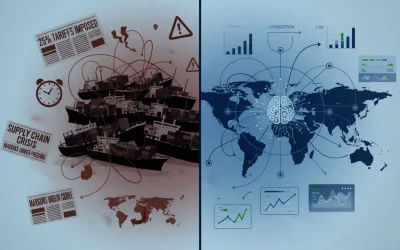
It’s no secret that global supply chains are under pressure. Definitely, April 2025 was a wake-up call. With tariffs surging and trade lanes rerouting overnight, companies across industries found themselves scrambling for alternatives. And in the middle of it all stood an unexpected hero: the third-party logistics provider.
No longer just the execution arm, today’s 3PL is being asked to step up — not just to move goods, but to help rethink how supply chains are designed, diversified, and defended. This shift is more than operational or tactical. It’s strategic.
For more than 25 years I’ve been part of the 3PL Industry. We discussed partnerships with our customers, even mentioned that in our contracts. But although the intention was always there, really discussing the bigger mutual picture was not always the practice. Sharing much more of each other’s business intelligence and data, followed by in-depth strategic discussions with Executive and C-level leadership from either side on the table needs to become the new normal. The momentum to lift all this has never been better than today.
Some key thoughts on the redefinition of the 3PL role:
1. From Cost Efficiency to Resilience Planning:
Traditional KPI’s like freight costs and warehouse throughputs still matter — but they’re no longer enough. Agility and speed will be the additional decisive metrics: How fast can you re-route? Where are your plan B or C storage and distribution locations? What’s your lead time if a port shuts down?
2. From Freight Forwarder to Scenario Planner:
The best 3PL’s should not just be following instructions — they should be running simulations. “What if the EU retaliates?” “How will this affect our component lead times?” Logistics is more and more a dynamic risk exercise that needs to be embedded in strategic planning.
3. From Warehouse Provider to Regional Flex Hub:
Modern 3PL’s should help clients moving their inventory closer to consumption or duty-advantaged zones. It’s not just about storing stuff — it’s about strategic positioning.
4. From Vendor to Strategic Partner:
Shippers should invite their 3PL’s for C-suite discussions and supply chain reviews. They need to help and facilitate shippers in deciding not just how to ship — but what to source and where to land it.
This shift brings two big implications for 3PL’s and supply chain leaders:
3PL’s need to alter their strategic and commercial narrative. If you’re still marketing your speed and price, you’re underselling. Your ability to buffer shocks & stocks, to actively reroute, and to deploy inventory regionally is your new differentiator.
Businesses need to rethink what they’re buying. If you’re only procuring logistics as a commodity, you’re missing out on an important strategic component. The right 3PL partner can make or break your response time in the next crisis. And the next crisis will show up!
The days of treating logistics like a post-purchase function are over. For companies navigating uncertainty, logistics is the capability that lets strategy stay agile. If you’re a 3PL: lean into that role. Build the tools. Bring the insight. Be bold. If you’re a business: ask more from your partners. Elevate the discussion.
In this new era, resilience doesn’t just live in operations — it rides on the shoulders of those who move the goods.
So, dear 3PL’s: in case you want to assess your infrastructure, your assets and your skills to not just become future proof but a real supply chain partner, let’s team up as we can maybe deliver the support you need.
And also, dear businesses: in case you’re in the need for more information, and/or want to challenge your today 3PL partners and their capabilities with the purpose to secure your global agility via their logistic infrastructures and skills, then let’s meet and discuss how we can help you and your 3PL partners.